 New topic
 Printable
| Author | Message |
I take back every bad thing I ever said about bees Only the stupid are STILL Prince fans. | |
- E-mail - orgNote -  Report post to moderator Report post to moderator |

 sigh, I don't know what happened, I tried to post and it gave me an error message, so ok here's the link to the article: sigh, I don't know what happened, I tried to post and it gave me an error message, so ok here's the link to the article:
Go to Google News Threats to Bumblebees Fly Under Radar By JEFF BARNARD – Oct 7, 2007 GRANTS PASS, Ore. (AP) — Looking high and low, Robbin Thorp can no longer find a species of bumblebee that just five years ago was plentiful in northwestern California and southwestern Oregon. Thorp, an emeritus professor of entomology from the University of California at Davis, found one solitary worker last year along a remote mountain trail in the Siskiyou Mountains, but hasn't been able to locate any this year. He fears that the species — Franklin's bumblebee — has gone extinct before anyone could even propose it for the endangered species list. To make matters worse, two other bumblebee species — one on the East coast, one on the West — have gone from common to rare. Amid the uproar over global warming and mysterious disappearances of honeybee colonies, concern over the plight of the lowly bumblebee has been confined to scientists laboring in obscurity. But if bumblebees were to disappear, farmers and entomologists warn, the consequences would be huge, especially coming on top of the problems with honeybees, which are active at different times and on different crop species. Bumblebees are responsible for pollinating an estimated 15 percent of all the crops grown in the U.S., worth $3 billion, particularly those raised in greenhouses. Those include tomatoes, peppers and strawberries. Demand is growing as honeybees decline. In the wild, birds and bears depend on bumblebees for berries and fruits. There is no smoking gun yet, but a recent National Academy of Sciences report on the status of pollinators around the world blames a combination of habitat lost to housing developments and intensive agriculture, pesticides, pollution and diseases spilling out of greenhouses using commercial bumblebee hives. "We have been naive," said Neal Williams, assistant professor of biology at Bryn Mawr College in Pennsylvania. "We haven't been diligent the way we need to be." The threat has bumblebee advocates lobbying Congress to allocate more money for research and to create incentives for farmers to leave uncultivated land for habitat. They also want farmers to grow more flowering plants that native bees feed on. "We are smart enough to deal with this," said Laurie Adams, executive director of the Pollinator Partnership. "There is hope." Companies in Europe, Israel and Canada adapted bumblebees to commercial use in the early 1990s, and they are now standard in greenhouses raising tomatoes and peppers. Demand is growing as supplies of honeybees decline, especially for field crops such as blueberries, cranberries, watermelon, squash, and raspberries, said Holly Burroughs, general manager for production for the U.S. branch of Koppert Biological Systems Inc., a Netherlands company that sells most of the commercial bumblebees in the U.S. One new customer is Tony Davis of Quail Run Farm in Grants Pass. He has long depended on volunteer bumblebees to fertilize the squash, cucumbers, tomatoes and eggplant he grows outdoors for sale in growers' markets. When he started growing strawberries in greenhouses this year to get a jump on the competition, he bought commercial bumblebee hives to fertilize them. "Without bumblebees, I would be out of business. I don't think I could hand-pollinate all these plants," he said. Scientists hoping to pinpoint the cause of the nation's honeybee decline recently identified a previously unknown virus, but stress that parasitic mites, pesticides and poor nutrition all remain suspects. Unlike honeybees, which came to North America with the European colonists of the 17th century, bumblebees are natives. They collect pollen and nectar to feed to their young, but make very little honey. A huge problem facing scientists is how "appallingly little we know about our pollinating resources," said University of Illinois entomology Prof. May Berenbaum, who headed the National Academy of Sciences report. Scott Black, executive director of the Xerces Society for Invertebrate Conservation in Portland, worries that on top of pesticides and narrowing habitats, disease could be the last straw for many of the bee species. "It definitely could all come crashing down," he said. On the Net: More on bumblebees: http://www.bumblebee.org Hosted by Copyright © 2007 The Associated Press. All rights reserved. Only the stupid are STILL Prince fans. | |
| - E-mail - orgNote - Report post to moderator |
| - E-mail - orgNote - Report post to moderator |
I like bees  | |
| - E-mail - orgNote - Report post to moderator |

I'm a bit scared of those round fluffy ones 

we only got these ones here  | |
| - E-mail - orgNote - Report post to moderator |
ZombieKitten said: I'm a bit scared of those round fluffy ones
we only got these ones here  huge bee alert! huge bee alert!
its wasps I don't like  | |
| - E-mail - orgNote - Report post to moderator |
jami0mckay said: I like Bees
its wasps I don't like 


| |
| - E-mail - orgNote - Report post to moderator |

PANDURITO said: jami0mckay said: I like Bees
its wasps I don't like

the one on the top right from wasp looks like Carla from cheers | |
| - E-mail - orgNote - Report post to moderator |

| |
| - E-mail - orgNote - Report post to moderator |
jami0mckay said: its wasps I don't like
Yeah! It's wasps that I hate with a passion (I was stung by one as a child) Wasps don't serve any purpose, do they? They don't make honey or anything like that Only the stupid are STILL Prince fans. | |
| - E-mail - orgNote - Report post to moderator |
I like honeybees! 
They're cute and fuzzy!  | |
| - E-mail - orgNote - Report post to moderator |
jami0mckay said: PANDURITO said:
the one on the top right from wasp looks like Carla from cheers  Fuck the funk - it's time to ditch the worn-out Vegas horns fills, pick up the geee-tar and finally ROCK THE MUTHA-FUCKER!! He hinted at this on Chaos, now it's time to step up and fully DELIVER!!

KrystleEyes 22/03/05 | |
| - E-mail - orgNote - Report post to moderator |

I heard an article on NPR last month about this. Apparently it's world wide. | |
| - E-mail - orgNote - Report post to moderator |

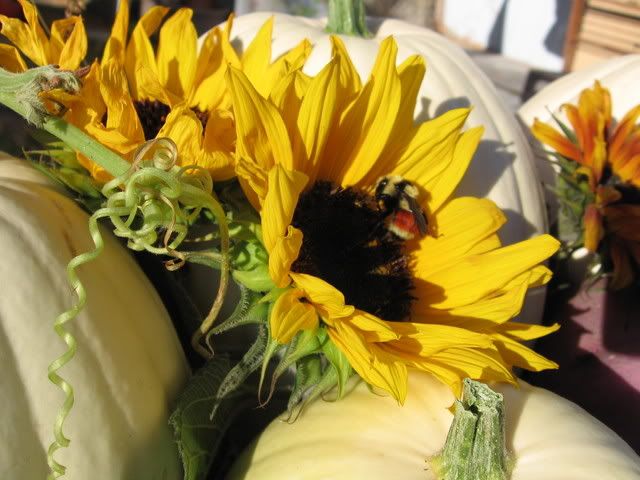
it was kind of neat in the garden at the farm to notice 4 distinct kinds of bees all out there at once working away something so small we take for granted... but if they go think of all the orchards that will be fooked.  She couldn't stop crying 'cause she knew he was gone to stay She couldn't stop crying 'cause she knew he was gone to stay | |
| - E-mail - orgNote - Report post to moderator |

Jezebel said: jami0mckay said: its wasps I don't like
Yeah! It's wasps that I hate with a passion (I was stung by one as a child) Wasps don't serve any purpose, do they? They don't make honey or anything like that I think they make chutney | |
| - E-mail - orgNote - Report post to moderator |
jami0mckay said: Jezebel said: Yeah! It's wasps that I hate with a passion (I was stung by one as a child) Wasps don't serve any purpose, do they? They don't make honey or anything like that I think they make chutney | |
| - E-mail - orgNote - Report post to moderator |
ZombieKitten said: jami0mckay said: I think they make chutney and spiders make gravy | |
| - E-mail - orgNote - Report post to moderator |
jami0mckay said: ZombieKitten said: and spiders make gravy on the bottom of my shoe | |
| - E-mail - orgNote - Report post to moderator |
ZombieKitten said: jami0mckay said: and spiders make gravy on the bottom of my shoe | |
| - E-mail - orgNote - Report post to moderator |
I thought this was some kind of promo for Bee Movie    I never met you, but I LOVE you & I will forever!! Thank you for being YOU - my little Princey, the best to EVER do it I never met you, but I LOVE you & I will forever!! Thank you for being YOU - my little Princey, the best to EVER do it | |
| - E-mail - orgNote - Report post to moderator |

jami0mckay said: ZombieKitten said: and spiders make gravy  surviving on the thought of loving you, it's just like the water
I ain't felt this way in years... | |
| - E-mail - orgNote - Report post to moderator |
